Last updated: August 2026.
Dengue fever affects an estimated 390 million people globally every year, and India sees a sharp spike in cases every monsoon season.
If you or a family member is recovering from dengue, the two biggest worries are usually the same: “How do I get my platelet count back up?” and “What should I eat to recover faster?”
This guide covers exactly that – backed by clinical facts, not myths – plus where Ayurvedic nutritional support can fit in alongside your doctor’s treatment plan.
Medical disclaimer: This article is for general information only and is not a substitute for professional medical advice, diagnosis, or treatment.
Dengue can become severe quickly. Always follow your treating doctor’s instructions and seek emergency care if warning signs appear
(see section below).
What Happens to Your Platelet Count in Dengue?
- Normal platelet count: 150,000–450,000 per microliter (µL) of blood
- In dengue: Counts can fall as low as 10,000–50,000/µL during the critical phase (typically days 3–7 of illness)
- Why it drops: The dengue virus temporarily affects bone marrow production and speeds up platelet destruction
- Recovery pattern: Once the critical phase passes, platelets usually start climbing again on their own – often rising by 30,000–50,000/µL per day – with most patients back to normal range within 1–2 weeks
- When it’s serious: A count below 50,000/µL needs close medical monitoring; below 20,000/µL usually needs hospital-level care
Key point: Platelet recovery in dengue is primarily driven by your bone marrow naturally recovering after the viral phase passes – diet and supportive nutrition can support this process, but they don’t replace medical monitoring or emergency treatment when needed.
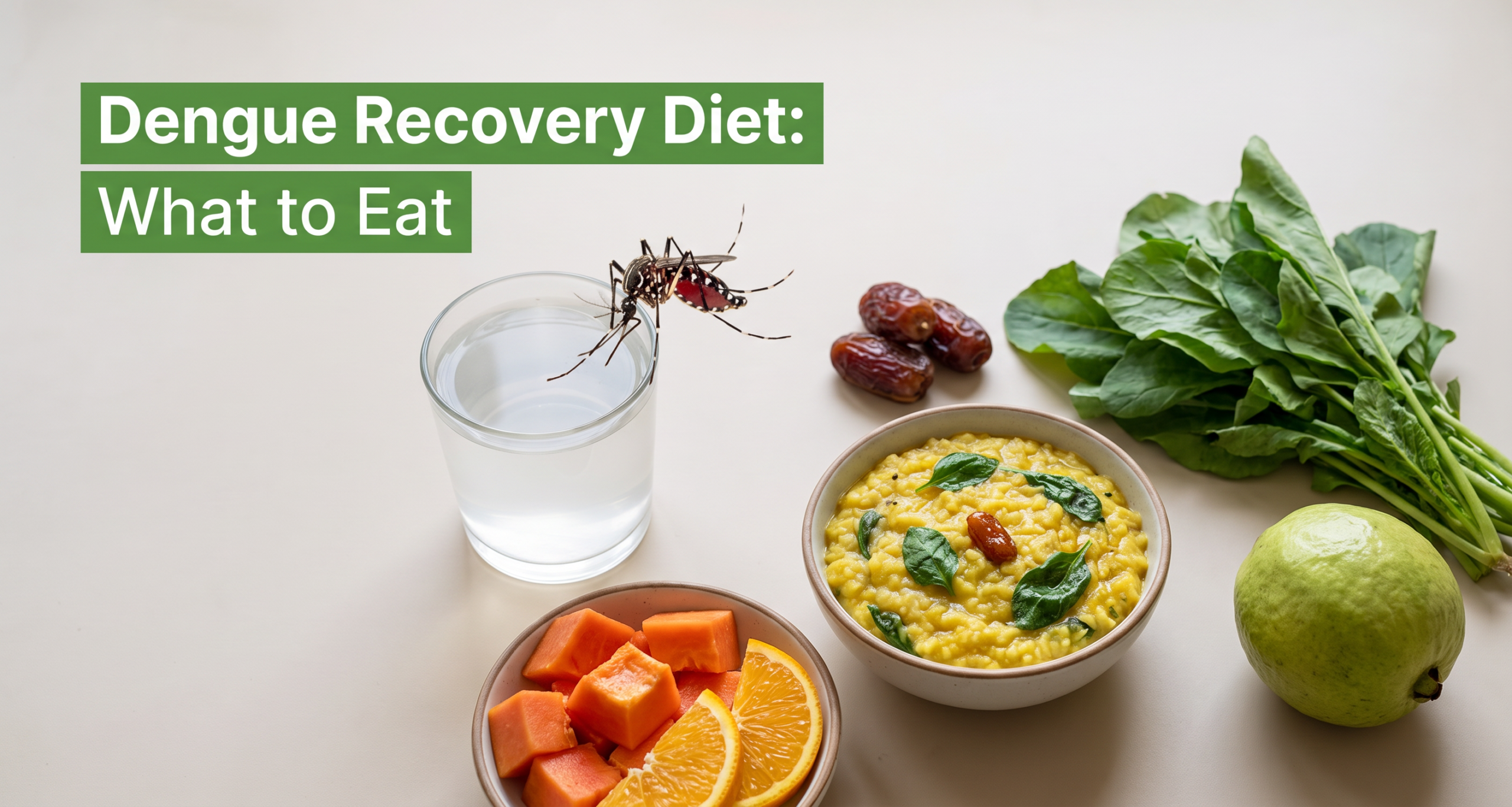
Dengue Recovery Diet: What to Eat
A nutrient-dense, easy-to-digest diet supports your immune system and helps your body recover strength during dengue. Focus on:
- Hydration first – coconut water, ORS, buttermilk, soups, and plain water to prevent dehydration from fever and vomiting
- Vitamin C-rich foods – oranges, amla, guava – support immune function
- Iron-rich foods – spinach, pomegranate, dates – help counter fatigue and weakness
- Folate-rich foods – beans, leafy greens – support blood cell production
- Light, easily digestible meals – khichdi, soft rice, boiled vegetables, dal – easier on a weak appetite
- Papaya leaf extract – widely used in traditional Indian home care; some small studies suggest possible benefit, though large clinical trials are still limited
Foods to Avoid
- Oily, fried, and spicy food (harder to digest during fever)
- Caffeine and alcohol (dehydrating)
- Raw or undercooked food (infection risk when immunity is low)
Home Care Tips for Faster Recovery
- Rest completely – the body needs energy for healing, not activity
- Monitor temperature and hydration daily
- Track platelet count via repeat blood tests as advised by your physician
- Watch for warning signs (below) – dengue can worsen quickly even after the fever breaks
- Avoid painkillers like aspirin or ibuprofen – these can increase bleeding risk in dengue; paracetamol is generally preferred, but always confirm with your doctor
Warning Signs – Seek Emergency Care Immediately
Contact a doctor or hospital right away if you notice:
- Severe abdominal pain or persistent vomiting
- Bleeding from gums, nose, or in vomit/stool
- Cold, clammy skin or restlessness
- Rapid breathing or extreme fatigue
- Platelet count dropping below 50,000/µL with any of the above symptoms
Dengue Hemorrhagic Fever (DHF) and Dengue Shock Syndrome (DSS) are medical emergencies. Do not rely on home remedies or supplements alone if these symptoms appear.
Where Ayurvedic Nutritional Support Fits In
Traditional Indian remedies – including papaya leaf, Giloy (Tinospora cordifolia), and pomegranate-based formulations – have long been used in Indian households as supportive nutrition during dengue recovery, alongside standard medical treatment. They’re not a treatment for dengue itself, but many people use them to support overall wellness, appetite, and daily nutrition needs during the recovery phase.
If you’re looking for convenient, standardized ways to get these traditional ingredients, Zenius India offers three Ayurvedic nutritional supplements formulated for general wellness support during recovery phases (to be used alongside, never instead of, your doctor’s treatment):
An Ayurvedic tablet formulation combining Sadabahar (Vinca) and traditional herbal ingredients, used as general nutritional support during recovery phases.
A blood-purifier-style Ayurvedic capsule blend, positioned for general immunity and wellness support during the recovery period.
Formulated with Carica papaya leaf extract, one of the most widely used traditional ingredients for nutritional support during recovery.
Important: These are Ayurvedic dietary/nutritional supplements Always consult your doctor before adding any supplement during illness, especially if you’re on other medication.
Frequently Asked Questions
Q: How long does it take for platelet count to return to normal after dengue?
A: Most patients see platelet counts normalize within 1–2 weeks after the critical phase passes, as bone marrow function recovers naturally.
Q: Can diet alone increase platelet count in dengue?
A: Diet supports overall recovery and nutrition, but the body’s natural healing process mainly drives platelet recovery in dengue. Severe drops need medical monitoring and, in some cases, hospital treatment.
Q: Is papaya leaf extract scientifically proven to cure dengue?
A: No. Some small studies suggest possible supportive benefit for platelet levels, but papaya leaf extract is not a proven cure or treatment for dengue, and larger clinical trials are still needed. It should only be used as a traditional dietary support, not as a substitute for medical care.
Q: When should I go to the hospital for dengue?
A: Go immediately if you notice bleeding, severe abdominal pain, persistent vomiting, restlessness, cold/clammy skin, or a platelet count below 50,000/µL — especially with any of these symptoms.
Q: Are Ayurvedic supplements safe to take during dengue?
A: They can be used as general nutritional support, but should always be discussed with your treating doctor first, particularly around any medication interactions.